
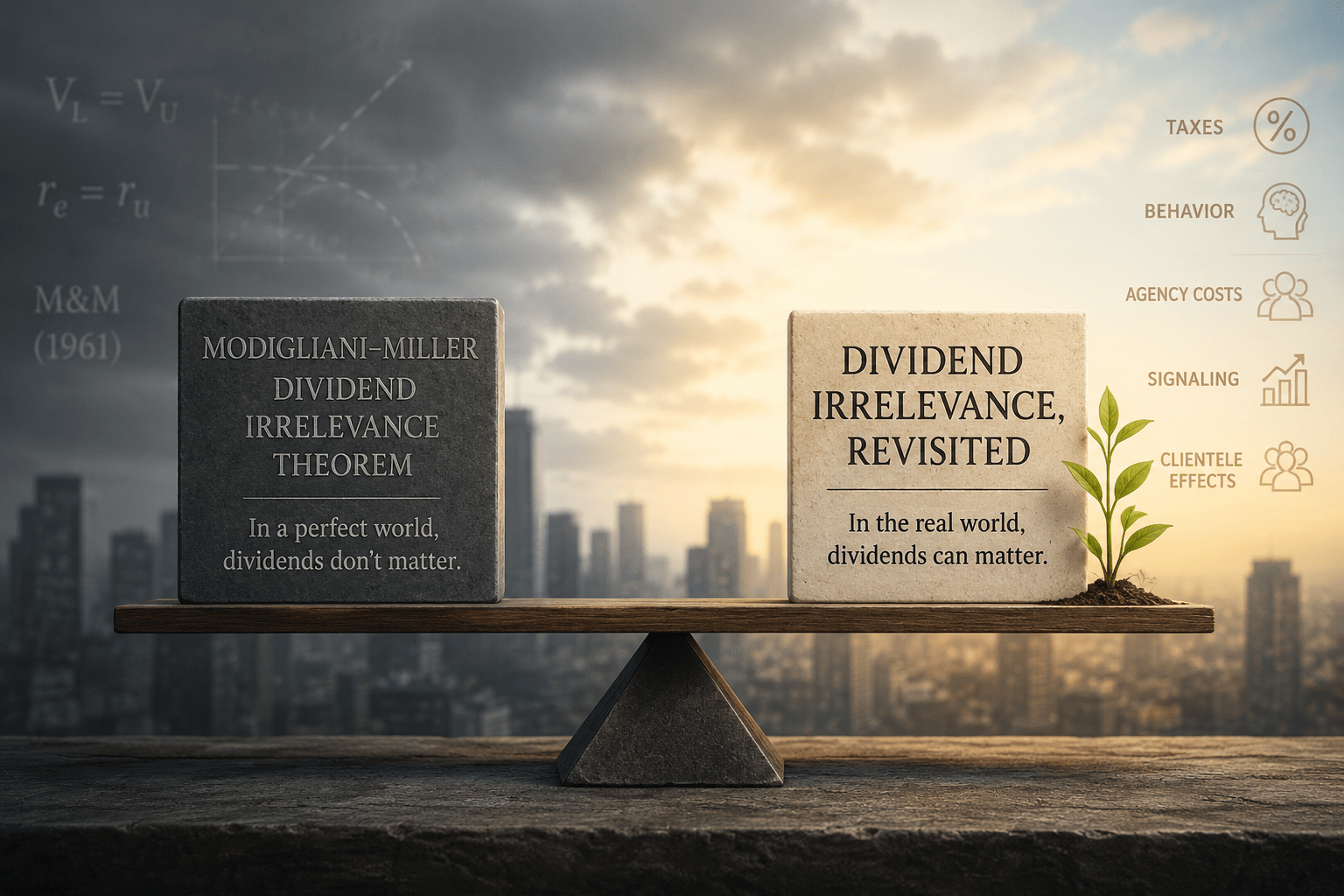
The Modigliani-Miller Dividend Irrelevance Theorem is one of those ideas that every finance student encounters and most never fully reconcile with how markets actually behave. The theorem holds that, under a set of idealized assumptions, a company’s dividend policy has no effect on its value or on shareholder wealth. Whether a company pays out its earnings or retains them, investors end up in the same place. It’s elegant, internally consistent, and widely taught. I think it’s also incomplete in a way that matters quite a bit once you’re actually living off a portfolio.
What the Theorem Says
In a world with no taxes, no transaction costs, and rational investors, Modigliani and Miller argued that dividend policy is a wash. If a company pays a dividend, the share price drops by roughly the dividend amount on the ex-dividend date—you’ve simply converted equity into cash, and your total wealth is unchanged. If a company retains earnings instead, you can create a “homemade dividend” by selling a few shares whenever you need cash. Either way, the argument goes, you end up with the same total value.
The theorem rests on two ideas:
- A dividend simply converts equity value into cash—the price drop on the ex-dividend date offsets the payout, leaving total wealth unchanged.
- An investor can replicate any dividend they want by selling shares—making a company’s actual payout policy irrelevant to what an investor can do with their position.
As a description of value creation inside a business, this is hard to argue with. Paying or not paying a dividend doesn’t, by itself, make a company worth more or less. Where I think the theorem runs into trouble is in the leap from “the firm’s value is unaffected” to “the investor’s situation is equivalent.” Those are different claims, and the gap between them is exactly where real markets live.
Where the Theory Meets a Messier Market
In theory, a stock’s price reflects the present value of a company’s future cash flows. In practice, prices move on sentiment, macro headlines, sector rotation, and narrative—often with little connection to what’s actually happening on the company’s income statement. A profitable, healthy business can see its stock drop 20 or 30 percent because the market has soured on its sector or because a single quarter missed an estimate by a penny. The balance sheet didn’t change. The mood did.
This matters enormously for the “homemade dividend” half of the theorem. If a company retains all its earnings and your only way to access that value is to sell shares, you’re forced to sell at whatever price the market happens to be offering that day—even if that price has little to do with the business’s actual earning power. You’re not extracting value on your terms; you’re extracting it on the market’s terms, and the market’s terms can be temporarily, sometimes persistently, disconnected from reality.
A dividend sidesteps this. It’s cash generated by the business and paid directly to you. The stock price doesn’t have to “agree” with anything for that cash to show up in your account.
Ownership vs. Liquidation
The standard rebuttal here is that the dividend doesn’t actually shield you from anything—the share price drops by roughly the dividend amount on the ex-dividend date, so you’re in the same spot either way: a smaller stock position plus some cash, still subject to the same sentiment-driven swings.
I don’t think this settles the issue, because it misses what doesn’t change. When you receive a dividend, your number of shares stays exactly the same. Your ownership stake, your claim on future earnings, your seat at the table—all untouched. When you create a homemade dividend by selling shares, you permanently give up a slice of that future income stream to get cash today. You haven’t just rearranged your wealth between “stock” and “cash”—you’ve reduced your ownership of the business that’s supposed to keep generating returns for you.
A rental property is a useful way to think about this. If your tenant pays rent, you receive cash and you still own the whole property. If instead you sell off a room to raise cash, you get money now, but you’ve permanently given up the future rent that room would have generated. What you still own after the transaction is what matters—and only one of these leaves you whole.
And critically, the rent keeps coming. The landlord’s rental income doesn’t come from a finite reserve that depletes over time—it comes from tenants paying month after month. Dividends work the same way. They’re funded by new cash flowing into the business from customers buying products and services, revenue that gets generated fresh every quarter. That cash flow doesn’t come from a fixed pool that depletes over time; it’s continuously replenished as long as the business remains healthy. Your shares of ownership, by contrast, are finite—you have exactly as many as you bought. Every time you sell one to create a homemade dividend, that share is gone. The business keeps generating revenue, but your claim on it just got a little smaller.
Retained Earnings Still Have to Clear the Market
There’s a related argument for why retaining earnings can actually beat paying them out: a well-run company can reinvest at a high rate of return, compounding shareholder value faster than a dividend check ever could. This is the Berkshire Hathaway model, and it’s a legitimate strategy when management allocates capital well.
But notice what this quietly assumes: that the market will eventually recognize and price in the value created by that reinvestment. A company might make a genuinely excellent capital allocation decision—one that meaningfully increases future earnings—and the market might simply not reflect that for years. The value is real, sitting on the balance sheet and in future cash flows. But an investor’s access to it still runs entirely through whatever price the market is willing to pay on the day they need to sell.
A dividend converts business profits into investor wealth without requiring the market’s permission. Retained earnings create value that stays locked behind market sentiment until an investor cashes out—and that sentiment is precisely the thing that can’t be relied upon.
Conclusion: Two Different Questions
I don’t think Modigliani-Miller is wrong about what it actually claims. In a frictionless world with continuously efficient pricing, dividend policy really wouldn’t matter to firm value, and the theorem remains a useful baseline for understanding that paying a dividend doesn’t, by itself, make a company worth more.
But “doesn’t change what the company is worth” and “doesn’t matter to the investor” are two different claims, and I think they get collapsed into one more often than they should. In a world where prices can disconnect from fundamentals for extended periods—sometimes for years—the mechanism by which an investor actually receives value matters. A dividend is a realization event that doesn’t depend on the market’s cooperation. Selling shares is a realization event that depends on it entirely.
This is part of why I think about investing in two phases—what I call Wealth Accumulation and Wealth Harvest. During accumulation, with no near-term need for cash flow, sentiment-driven noise in prices mostly washes out over time, and pure growth through a total market index fund makes sense. But as the portfolio moves toward harvest—toward actually needing to produce usable income—the reliability of how that income arrives matters more than any theorem that says it shouldn’t. Being forced to sell shares at a bad price because the market is in a mood is a very different experience than collecting a dividend regardless of what the ticker says that day.
Modigliani-Miller is a good model for thinking about what creates value inside a business. It’s a weaker model for thinking about how investors actually experience that value—and that gap is worth taking seriously.
Discover more from Bryant Quick
Subscribe to get the latest posts sent to your email.

