
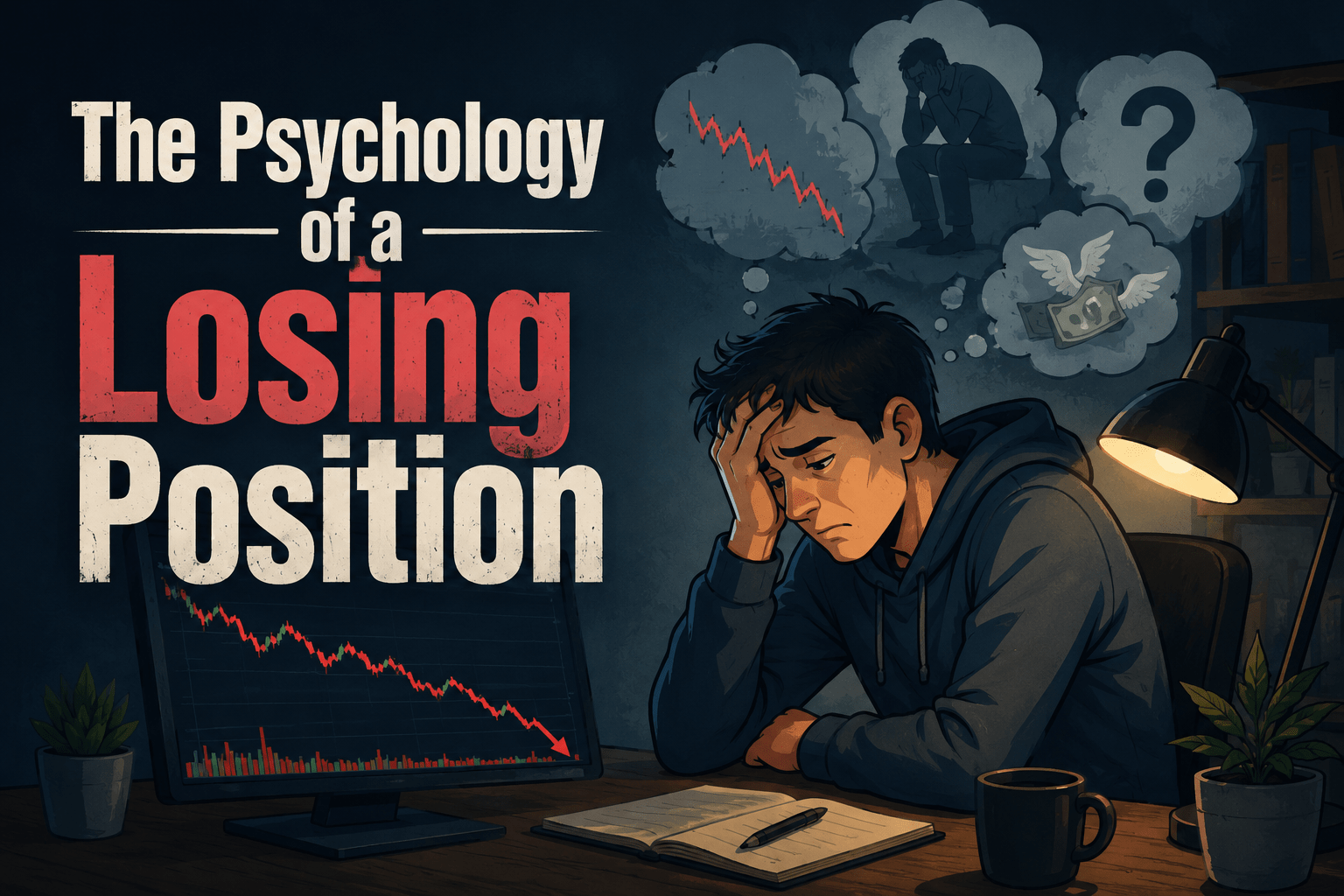
Every investor eventually holds a losing position. Whether it’s a stock that has dropped 10% or 40%, the experience is remarkably consistent: it feels different from a paper loss on an index fund you’ve held for a decade. Individual positions come with a story—a reason you bought, a price you paid, an expectation you formed. And when that story isn’t playing out, your brain works against you in ways that are both predictable and dangerous.
Behavioral finance has documented a set of cognitive biases that specifically distort how investors think about losing positions. These biases are not character flaws. They are hardwired features of human psychology. But understanding them is the first step toward making decisions based on logic rather than emotion.
Anchoring
Anchoring is the tendency to fixate on a specific reference point—most commonly, the price you paid for an asset—and allow that number to dominate your thinking. If you bought a stock at $80 and it’s now trading at $50, the $80 anchor shapes how you see the situation. You think of yourself as being “down $30,” and that framing influences every subsequent decision.
The problem is that your purchase price is completely irrelevant to the stock’s future performance. The market does not know what you paid. The stock does not know what you paid. The only question that matters is: given everything you know today, is this an attractive investment at $50? Your $80 purchase price adds zero information to that analysis. It only adds emotion.
Anchoring also manifests as “waiting to get back to even”—holding a losing position with the goal of recovering to your cost basis before selling. This is a particularly destructive form of the bias because it uses an arbitrary number to make a forward-looking decision. A stock’s path back to your purchase price is no more likely than any other price target. The market has no memory of where you entered.
“The price you paid is not a fact about the world. It’s a fact about you. The market doesn’t care.”
Daniel Kahneman
The Sunk Cost Fallacy
The sunk cost fallacy is the tendency to continue a course of action because of past investment—money, time, or effort already spent—rather than based on the current and future merits of the decision. In investing, this looks like holding a declining stock because you’ve already lost so much that selling now feels like admitting defeat.
The logic sounds reasonable on the surface: “I’m already down 40%, I might as well hold and see what happens.” But this reasoning is flawed. The money already lost is gone regardless of what you do next. It should have no bearing on your decision to hold or sell. The only relevant question is what the next dollar kept in this position is likely to do, compared to what that dollar could do elsewhere.
The right question is never “how much have I lost?” The right question is always “what is the best use of my capital right now?”
Sunk cost thinking keeps investors trapped in bad positions long after the rational case for holding has deteriorated. It confuses loyalty to a past decision with sound financial judgment. The stock doesn’t care how long you’ve held it or how much you’ve lost. Your capital does not know it owes you a recovery.
Loss Aversion
Loss aversion is one of the most well-documented findings in behavioral economics. Research by Daniel Kahneman and Amos Tversky found that the psychological pain of a loss is roughly twice as powerful as the pleasure of an equivalent gain. A $1,000 loss hurts approximately twice as much as a $1,000 gain feels good. This asymmetry is baked into human psychology.
In the context of a declining position, loss aversion creates two opposite but equally destructive behaviors. The first is paralysis—refusing to sell and lock in a loss because the pain of making it “real” is psychologically unbearable. The second is panic selling—capitulating at the worst possible moment because the ongoing pain of watching a loss grow becomes intolerable. Both behaviors are driven by emotion rather than analysis.
Loss aversion also leads investors to take asymmetric risks. Someone who is down 40% may start accepting significantly more risk in hopes of recovering their losses, even when the odds do not justify it. The motivation is not opportunity—it is the avoidance of locking in a painful outcome. This is sometimes called “shooting for the moon” to avoid admitting defeat, and it often ends badly.
“Losses loom larger than gains. The aggravation that one experiences in losing a sum of money appears to be greater than the pleasure associated with gaining the same amount.”
Daniel Kahneman and Amos Tversky
The Disposition Effect
The disposition effect, first identified by researchers Hersh Shefrin and Meir Statman in 1985, describes a consistent pattern of investor behavior: people tend to sell winning positions too early and hold losing positions too long. It is essentially loss aversion and anchoring working together in real portfolio behavior.
The effect has been documented extensively in individual investor data. Investors tend to realize gains quickly—locking in the good feeling—while deferring the pain of realizing losses by simply not selling. The result is a portfolio that trends toward becoming a collection of losers while winners are periodically harvested. This is close to the opposite of what a rational investor would do.
Interestingly, tax considerations should actually produce the opposite behavior. In a taxable account, it is often beneficial to harvest losses and defer gains. The disposition effect causes many investors to do the reverse—harvesting gains and sitting on losses—which is both psychologically driven and tax-inefficient.
Confirmation Bias
Once you hold a position—especially a losing one—confirmation bias kicks in. You begin to unconsciously seek out information that supports your original thesis while discounting or ignoring information that contradicts it. You read the bullish articles. You find the analyst who still has a buy rating. You focus on the near-term catalysts that might spark a recovery.
This is not deliberate dishonesty. It is how the human brain works when it has skin in the game. But the consequence is that your ongoing assessment of the investment is systematically distorted by the fact that you own it. The information you consume is being filtered through your desire for a particular outcome.
The antidote is to deliberately seek out the strongest counterarguments to your thesis. Ask yourself: what would someone who is short this stock say? What is the bear case, and is it credible? If you find yourself unable to articulate a strong bear case, that is a sign that you may be filtering your information.
“The human mind is a lot like the human egg, and the human egg has a shut-off device. When one sperm gets in, it shuts down so the next one can’t get in. The human mind has a big tendency of the same sort.”
Charlie Munger
The Endowment Effect
The endowment effect is the tendency to overvalue something simply because you own it. Research by Richard Thaler found that people consistently demand more money to give up an asset they already own than they would be willing to pay to acquire the same asset. Ownership itself creates perceived value above and beyond the asset’s market price.
For investors, this means that holding a stock makes you irrationally attached to it. You assigned meaning to the purchase decision—you researched it, you believed in it, you took a position. That psychological ownership makes it harder to evaluate the stock objectively. You are no longer just analyzing a business; you are defending a decision you made.
A useful exercise is to imagine that you do not own the stock and that your portfolio is entirely in cash. Would you buy this stock today, at the current price, given everything you know? If the honest answer is no—or even “I’m not sure”—that tells you something important. The endowment effect is likely preventing you from thinking clearly.
Conclusion: Think Like a New Buyer
These biases do not operate in isolation. They compound and reinforce each other. Anchoring sets a false reference point. Loss aversion makes the thought of selling painful. The sunk cost fallacy provides a rationale for staying. Confirmation bias filters your information. The endowment effect makes you feel the stock deserves your loyalty. Together, they form a powerful force that can trap a rational investor in an irrational position for far too long.
The most effective tool for cutting through all of this is a simple reframe: pretend you are a new buyer with no history in this stock. You have no purchase price to anchor to, no loss to deny, no prior thesis to defend. All you have is the stock at its current price and everything you know about the business. Would you buy it? At what size?
If the answer to that question leads you to a different decision than the one you are currently making, that gap is your bias speaking. The goal is not to be perfect—no investor is—but to be aware. Self-awareness is the only practical defense against the parts of your brain that are wired for survival, not for navigating capital markets.
“The investor’s chief problem—and even his worst enemy—is likely to be himself.”
Benjamin Graham
Discover more from Bryant Quick
Subscribe to get the latest posts sent to your email.

