
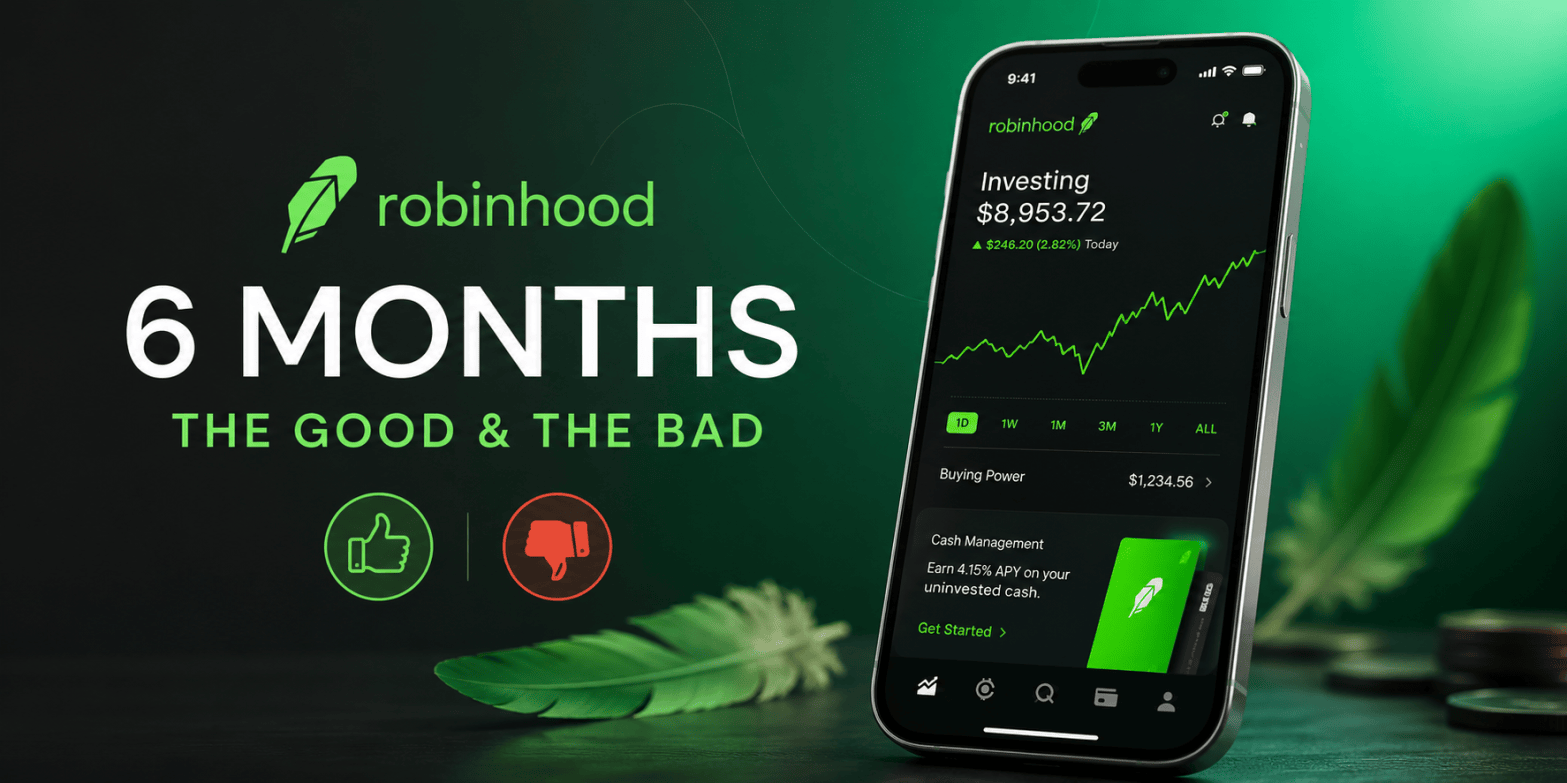
I’ve been a Fidelity customer since 2012, housing every investment account I owned there. In 2022, I even started putting every purchase on the Fidelity Visa Signature Rewards Card. Fully immersed in the Fidelity ecosystem, I never looked elsewhere.
Then Robinhood started showing up everywhere. So in April 2025, I opened an account, just to check out the interface everyone talks about. I didn’t fund it. I was just curious.
Five months later, Robinhood offered me their Gold Card: 3% cash back versus the 2% I was getting from Fidelity. The Gold Card carries a $50/year membership fee while Fidelity’s card is free, but the math still favored the Gold Card by a wide margin, so I decided to try it.
One Thing Led to Another
At first, I kept things separate. I’d earn cash back on the Robinhood Gold Card, redeem it to my Robinhood brokerage, withdraw it to my bank, transfer it to Fidelity, then invest it there. That worked for a while, but the friction wore on me. Eventually I gave in and started investing the cash back directly in Robinhood.
Around the same time, I was noticing things about the platform I genuinely liked. So when Robinhood offered a transfer bonus in December 2025, I moved roughly half my assets over from Fidelity.
Six months later, I moved them back to Fidelity. Here’s why.
What Robinhood Does Well
The app is the best in the business. No brokerage app I’ve tried comes close to Robinhood’s interface. Everything feels smooth and intentional, and it shows in the small details, especially fractional shares.
Two specifics stand out with fractional shares. First, Robinhood lets you queue dollar-based market orders outside of trading hours. Fidelity doesn’t allow this, and it’s a real annoyance when you want to place an order at 10 p.m. and just let it execute when the market opens. Second, Robinhood rounds fractional shares to six decimal places. Most firms round fractional shares to three decimal places, and that’s not precise enough — you almost always end up with a few stray cents sitting uninvested in your account. With six decimals, there’s never leftover change.
The product ecosystem is genuinely impressive. The Gold Card, brokerage, Roth IRA with a 3% match, and banking all work together well. The UTMA gifting feature for kids is excellent. And the banking product is a standout: 3.5% on a checking account if you hold at least $100k in assets with Robinhood. That’s a strong offer most banks won’t touch.
They have helped normalize investing. Robinhood has made a genuine effort to make investing feel fun and approachable rather than intimidating, effectively bringing it into the mainstream for younger generations. The “fun” factor is a double-edged sword I’ll get into later, but at face value, investing should be something people actually want to do, and Robinhood gets that part right.
Where Robinhood Falls Short
Customer service is inadequate. This is the big one. There’s no inbound phone number. Everything starts with an in-app AI chat agent, and only if your issue is complex enough do you get escalated to a human via phone or email. The people are friendly and helpful once you reach them, but the model itself isn’t built for anything beyond simple problems.
Research tools are thin. If you want to do real diligence on an investment, you’re going to a different platform to do it. Robinhood isn’t built for that kind of research.
The offerings don’t go deep enough. Compared to a full-service firm like Fidelity or Schwab, which carry virtually every product an investor could need, Robinhood’s lineup is limited. Robinhood has no 529 plans, no HSA accounts, no trust or estate accounts, and no SEP or SIMPLE IRAs. For someone in the accumulation phase of life managing multiple financial priorities — saving for kids’ education, optimizing healthcare dollars, or planning an estate — those absences matter. Robinhood works well for a taxable brokerage account, a Roth IRA, and a UTMA. Beyond that, you’ll need another institution.
The website is rough. The app is excellent, but Robinhood’s investing website is one of the weaker ones in the industry, and there’s no dedicated website at all for the banking or credit card products.
I feel less secure with Robinhood than Fidelity. Some of this may just be psychological after over a decade with Fidelity, but one concrete difference justifies the feeling: Fidelity automatically signs me out of my desktop session after a period of inactivity. Robinhood doesn’t. My Robinhood session stays logged in indefinitely on desktop, which means an unattended or compromised device stays exposed far longer than it would on Fidelity. For an account holding real money, I’d like to see Robinhood adopt the same kind of automatic timeout. Just seeing this simple, surface-level difference in security leaves me feeling like there is probably more under the surface making it less secure.
Dividend payouts are consistently delayed. Robinhood lags behind when it comes to the timeliness of distributions. When I was holding VTI at both Robinhood and Fidelity simultaneously, Robinhood consistently paid out the dividend about two days after Fidelity. For instance, Fidelity credited the 2026 Q1 VTI dividend to my account on March 31st, while Robinhood didn’t deliver it until April 2nd.
The Harder Criticism: Psychology and Incentives
Robinhood gets a lot of criticism for designing its product around behavioral psychology, and there’s real truth to it, though I have mixed feelings about how damning that criticism actually is. Every company plays on human psychology to drive engagement and revenue; that’s not unique to Robinhood. But a few specifics are worth calling out directly.
Gamification encourages more frequent trading, which benefits Robinhood through Payment for Order Flow (PFOF). This is the downside of making investing fun. You want people to enjoy investing, but encouraging overactivity is bad for the individual. The instant cash-back redemption on the Gold Card is another example. Most cards credit your cash back once a month with your statement. Robinhood credits it instantly, which creates a small dopamine hit every time you spend, and that hit nudges people toward spending more so they can redeem more.
Prediction markets draw similar criticism, and again, I land somewhere in the middle. They don’t bother me personally because I have the self-control to leave them alone. But they clearly aren’t designed with the inexperienced investor in mind, and they can lead a new, young person astray. I don’t think it helps that they’re sitting right on the home screen underneath the primary investing section. That product deserves its own separate tab, similar to how crypto is handled.
Why I Moved Back
After six months of running real money through Robinhood, I transferred my assets back to Fidelity. Robinhood isn’t a bad platform. But it is an incomplete one.
The deciding factors were customer service and the inbound phone line, paired with the value of physical branches. As someone who thinks constantly about estate planning and making things easier for my family if something happens to me, that kind of accessibility matters more than a slicker app or a better cash-back rate. Trying to execute a will during an already stressful time with no customer service phone number and no physical branches would be a major inconvenience. Given that this inconvenience is avoidable, I’ll avoid it.
Robinhood does some things genuinely better than the legacy firms, and I don’t think the criticism it gets is entirely fair or entirely unfair. But when it comes to the money that matters most to my family’s long-term future, Fidelity remains the complete package where I feel most secure. Robinhood just isn’t there yet.
Discover more from Bryant Quick
Subscribe to get the latest posts sent to your email.

