
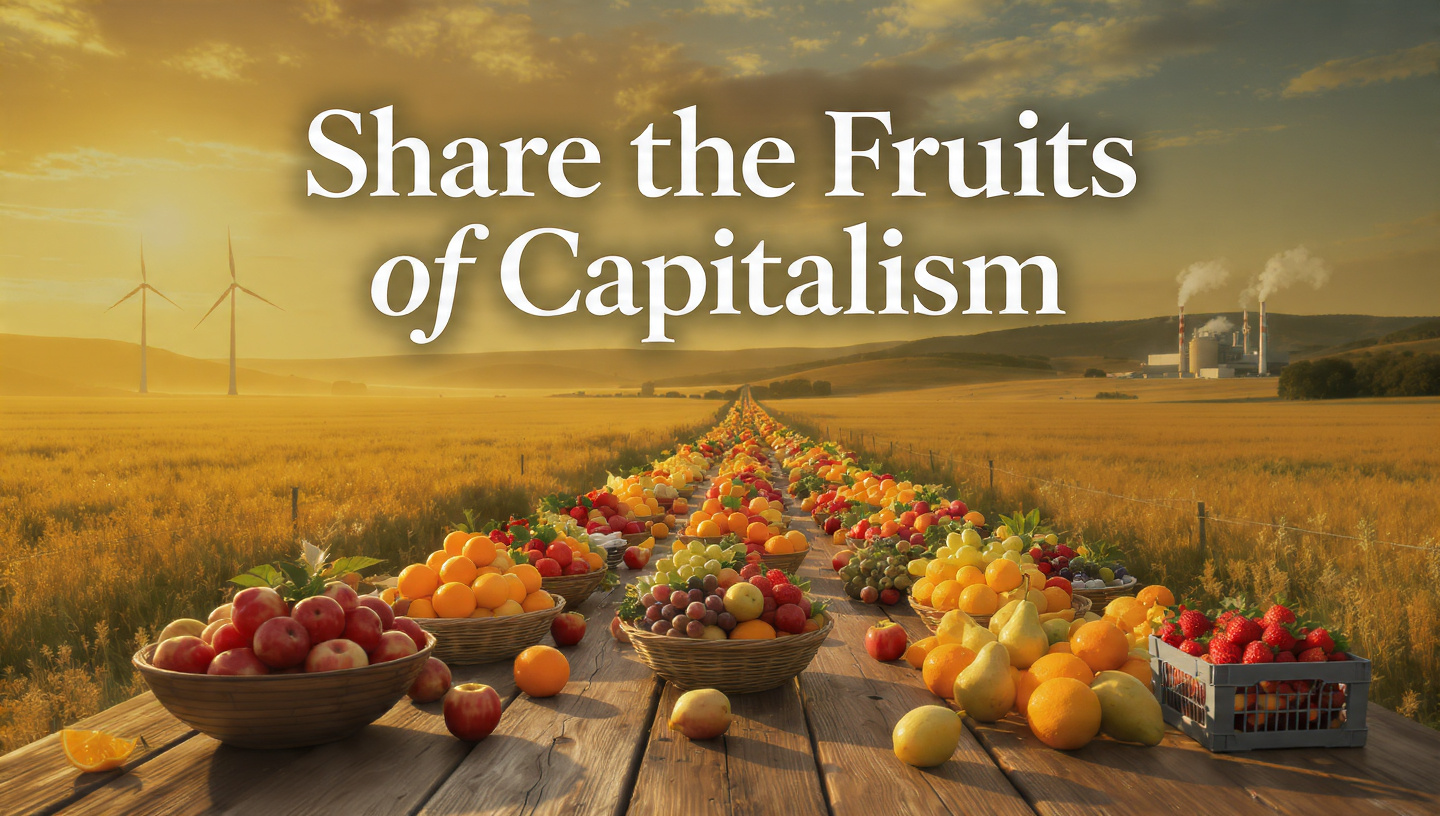
I want to make a case for something that used to be considered common sense: capitalism is the greatest economic system ever devised by human beings. Not perfect — nothing is — but the most effective wealth-creating, poverty-reducing, standard-of-living-improving engine in the history of civilization. And more importantly, I want to make the case that the fruits of this system are available to anyone willing to reach for them.
Too many people spend their time debating the flaws of capitalism without acknowledging the staggering scale of what it has accomplished. And in the meantime, millions of people are leaving enormous wealth on the table simply because no one taught them how to use the system that exists around them. That’s what this post is about.
The Scoreboard Doesn’t Lie
Let’s start with the data, because the data is overwhelming.
In 1820, roughly 90% of the world’s population lived in extreme poverty. By 2022, that number had fallen to under 9%. That is the most dramatic reduction in human suffering in recorded history, and it happened almost entirely in the era of industrialization, free markets, and global capitalism. The World Bank estimates that between 1990 and 2015 alone, over one billion people were lifted out of extreme poverty — a feat that happened fastest in the countries that embraced market economies.
China is the most striking example. After decades of Maoist central planning that produced famine, stagnation, and mass poverty, China began gradually introducing market reforms in 1978. In the four decades that followed, it experienced the fastest sustained economic growth in human history, pulling hundreds of millions out of destitution. The lesson isn’t complicated: when people are allowed to own property, compete in markets, and keep the fruits of their labor, economies grow and living standards rise.
The comparison between North Korea and South Korea tells the same story in sharper terms. Two countries, same peninsula, same culture, same starting point after the Korean War. One chose a centrally planned communist model. The other chose a market economy. Today, South Korea’s GDP per capita is more than 25 times that of North Korea. South Korea produces Samsung, Hyundai, and K-pop. North Korea produces famine and defectors. The experiment has been run. We have the results.
📊 By the Numbers: Capitalism vs. The Alternatives
- Global extreme poverty: 90% in 1820 → under 9% today
- South Korea’s GDP per capita: 25x+ that of North Korea
- Venezuela’s economy contracted by more than 80% between 2013 and 2021 under socialist policies
- The United States, with roughly 4% of the world’s population, produces approximately 25% of global nominal GDP
- Every country in the top 10 of the UN Human Development Index operates a market economy
Unequal Wealth vs. Equal Poverty
One of the most common critiques of capitalism is that it creates inequality. That’s true. Capitalism does produce unequal outcomes. Some people accumulate enormous wealth while others accumulate very little. Critics of capitalism treat this as a fatal flaw. I think they’re looking at the wrong metric.
Communism, by contrast, promises equality. And it delivers — but it’s an equality of deprivation. Under the Soviet Union, the average citizen and the factory worker were roughly equally poor, while the party elite lived in privilege behind closed doors. Cuba has universal healthcare, but it also has universal scarcity. North Korea achieves near-perfect income equality because almost everyone is equally impoverished. Equality of outcome sounds appealing, until you realize that the only outcome everyone shares is poverty.
I’ll take the inequality of capitalism every single time — because in a capitalist system, the floor rises. The poor in the United States today have access to smartphones, air conditioning, and medical care that the wealthiest people on earth couldn’t have imagined 100 years ago. The rising tide of capitalism lifts boats at every level. That’s not a guarantee of equality, but it’s something far more meaningful: the real, compounding improvement of human lives.
The question shouldn’t be “why do some people have so much?” The question should be “how do I get more of this?” And capitalism is the only system that has a genuine answer.
The Stock Market Changed Everything
Here’s where it gets personal. Because understanding capitalism is one thing, but actually participating in it and capturing its wealth-building power is another. And the single greatest tool ever created for allowing the average person to do exactly that is the stock market.
The S&P 500 has returned approximately 10% annually on average over the long run. That means money invested in a broad market index fund has historically doubled roughly every seven years. A 25-year-old who invests $500 per month and earns that historical average return would have more than $2.7 million by age 65. No business to run. No employees to manage. No special skills required. Just consistent participation in the capitalist engine.
The stock market didn’t always work this way for ordinary people. For most of its history, investing was expensive, complicated, and largely reserved for the wealthy. Broker commissions were steep. Information was asymmetric. The system favored insiders. But that world is gone. Commission-free trading, fractional shares, and zero-expense-ratio index funds have fundamentally democratized investing in a way that would have seemed impossible 30 years ago. There has never been a better time in human history to be a small investor.
Put the CEO to Work for You
Here’s a thought experiment I find genuinely powerful. The CEO of a Fortune 500 company works brutal hours. We’re talking about someone who is up before dawn, fielding calls from investors, managing thousands of employees, navigating regulatory environments, competing for market share, and ultimately responsible for the strategic direction of a multi-billion dollar enterprise. The stress alone would break most people.
You don’t have to do any of that. You can buy shares of that company — sometimes for less than the cost of a dinner out — and that CEO is now working for you. Every strategic decision they make, every market they enter, every product they launch, every quarter they grow earnings — you benefit from it proportionally as a shareholder. The labor of one of the most driven people on earth is now quietly building your wealth.
This is not a metaphor. It is the legal and financial structure of corporate ownership. Shareholders own the company. The executives are employed to create value for the shareholders. When you buy even a single share of Apple, Microsoft, or any other publicly traded company, you become a partial owner of that enterprise and a beneficiary of everything that ownership entails.
Extend that concept to an index fund like VTI, which holds thousands of companies across the entire U.S. economy, and you’re not just putting one CEO to work for you — you’re putting the entire executive leadership of American capitalism to work for you, simultaneously, for a microscopic 0.03% fee.
💡 The Ownership Mindset Shift
A person who complains that CEOs make too much money while refusing to invest in the stock market is opting out of sharing in that compensation. A person who buys index funds is capturing a slice of it. The system doesn’t care about your politics — it pays whoever shows up.
The Right Way to Participate: Save, Invest, and Stay the Course
None of this matters if you don’t actually do it. And here’s the honest truth: most people don’t. According to the Federal Reserve, around 40% of American adults have zero money invested in the stock market. That means almost half the country is watching capitalism create wealth around them and not capturing any of it. They are spectators in a game they could be playing.
Most people who could invest simply don’t, because they never learned to pay themselves first. Every dollar gets spent on consumption before savings are considered. The car payment, the subscriptions, the dining out — it all comes before the future. And then month after month, year after year, the wealth-building window gets smaller.
The principle is simple even if the habit is hard: treat your investment contribution like a bill. It gets paid first, before lifestyle decisions get made with whatever remains. Even 10-15% of income invested consistently in low-cost index funds over a working career produces life-changing results. The math is not subtle.
The Meme Stock Trap: Don’t Blow It
I also want to talk about the other way people fail to participate in capitalism properly: by confusing investing with gambling.
The meme stock phenomenon — GameStop, AMC, the crypto casino, the options plays people see on Reddit — has introduced millions of new participants to financial markets. That part is genuinely good. But it has also led many of them to their first experience of watching money evaporate overnight. And when that happens, the lesson they often take away is that the stock market is rigged, or that it’s only for rich people, or that it’s too dangerous for someone like them.
That lesson is wrong. But it’s an understandable conclusion when your first exposure to markets is speculation rather than investing. Speculation and investing are not the same thing. Speculation is a bet on price movement over a short timeframe. Investing is the long-term ownership of productive assets. The former is gambling dressed in financial language. The latter is how wealth is actually built.
SPIVA — S&P’s twice-yearly report on active management — consistently shows that over a 15-year period, more than 90% of actively managed large-cap funds underperform their benchmark index. These are professional fund managers with research teams, Bloomberg terminals, and decades of experience. They still can’t reliably beat the market. The individual retail investor trading meme stocks has essentially no chance of doing so consistently over time.
The answer isn’t to avoid the market. The answer is to use it correctly. Boring, broad, low-cost index funds — VTI, VOO, a target date retirement fund in your 401(k) — are the most reliable vehicles that have ever existed for participating in the capitalist wealth engine. Let the meme stock crowd speculate. You’re here to own the economy.
📋 How to Enjoy the Fruits of Capitalism
- Capture your employer match first. If your company offers a 401(k) match, that’s an immediate 50-100% return on your contribution. There is no better guaranteed return anywhere.
- Max your Roth IRA next. Tax-free growth over decades is one of the most powerful tools available to the average investor. Use it.
- Invest in broad, low-cost index funds. VTI, VOO, or a total market fund gives you instant ownership of the American economy at minimal cost.
- Automate it. Set up automatic contributions so the decision is made before lifestyle spending enters the picture.
- Stay the course. Markets will drop. They always do. The investors who build wealth are the ones who don’t panic and sell. Time in the market beats timing the market — every study on this subject reaches the same conclusion.
Share the Fruits
The title of this post is a call to action. Capitalism works best when more people participate in it, and it is most likely to endure when more people experience its benefits firsthand. A system that is perceived as exclusive — one where wealth-building is reserved for those who already have it — invites the kind of political backlash that erodes the very freedoms that make it work. A society where wealth-building knowledge is widely shared and widely acted upon is a more stable, more prosperous, and more durable society than one where those tools belong only to the already-wealthy.
If you understand index investing, teach someone who doesn’t. If your employer offers a 401(k) match and your coworker isn’t capturing it, say something. If you have children, start teaching them about ownership, compound growth, and the difference between an asset and a liability before they ever set foot in a classroom that won’t cover any of it.
Capitalism created the most prosperous civilization in human history. The stock market made that prosperity available to anyone with a brokerage account and a plan. The only way to lose is to not show up.
Show up.
Discover more from Bryant Quick
Subscribe to get the latest posts sent to your email.

